
DACHSER South Africa recognised for leading in skills development
At the 29th Logistics Achiever Awards ceremony held on Thursday evening, 2 November at Montecasino in Fourways, Gauteng, DACHSER SA scooped a Silver category award for leading in skills development.
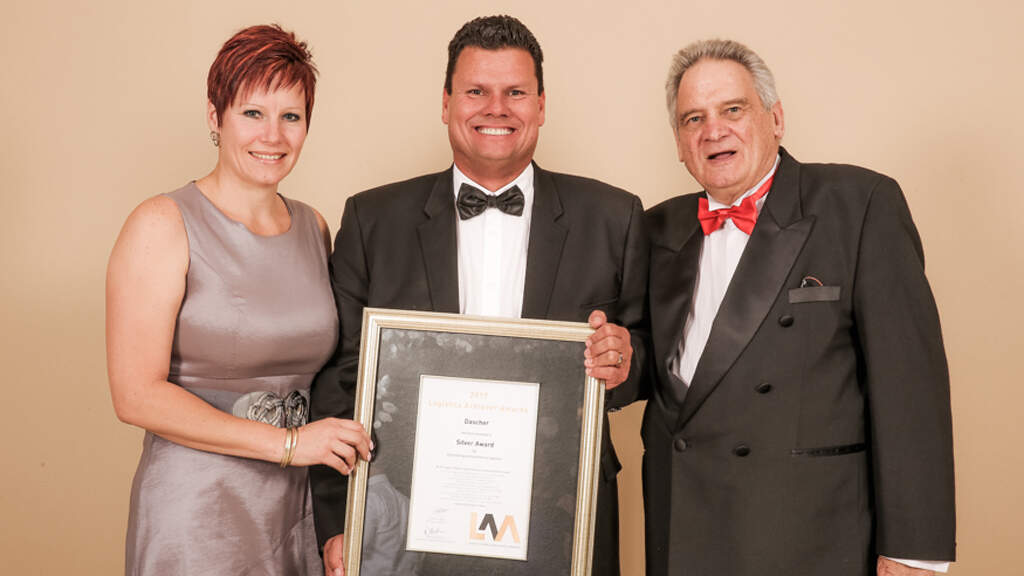
Samantha DuToit, Communications, PR & Marketing Manager, Detlev Duve, Managing Director DACHSER South Africa and Charles Dey, Chairman of Logistics Achiever Awards (left to right)
Managing Director of DACHSER SA, Detlev Duve, was at the black-tie ceremony to receive the award, of which all winners were only announced during the ceremony. Duve says of the achievement, “This is the first time that DACHSER South Africa has participated in the Logistics Achiever Awards. The application procedure was a rigorous process that included a site visit by a champion judge. We were very pleased to have made the shortlist. Receiving a silver award from among 89 entries is gratifying because it is an acknowledgement of DACHSER SA’s commitment to skills development for the logistics industry.”
Receiving a silver award from among 89 entries is gratifying because it is an acknowledgement of DACHSER SA’s commitment to skills development for the logistics industry.
Detlev Duve, Managing Director of DACHSER SA
The Logistics Achiever Awards is an annual event that recognises professionalism and excellence in the effective application of strategic, tactical, and operational logistics and supply chain management principles, concepts, and practices in Southern Africa. The awards include Bronze, Silver, Gold, Platinum and a Special Platinum Award.
Focus on soft skills
DACHSER SA was one of five first-time entrants this year in a growing field of entries. The qualifying process itself is highly detail-oriented, requiring commitment by both the judging panel and participating companies in the lead up to the final selection. The initial application process is followed up by a site visit and guidance provided to the company by the champion judge. Thereafter a shortlist is compiled and those companies are invited to a formal presentation and Q&A session before a panel of judges.
DACHSER SA believes that what set their application apart was the fact that they focused on the softer skills of people development rather than their core business. Duve says, “By necessity our work is highly process driven using sophisticated routing and tracking systems and specialist warehousing capabilities. While we could have put forward these aspects in our application for the Logistics Achiever Awards, we took the decision to focus on our skills development because this is something that we are highly passionate about, both in providing continuous learning to existing staff and equipping new entrants with the right skills.”
This is particularly relevant in the South African context, where unemployment sits at almost 30%, leaving many talented young learners with limited prospects upon matriculation. Duve says, “Our learnership programme has been developed in-house to equip learners with comprehensive logistics skills as well as basic work skills. Since 2012 we’ve had an annual intake of 15 learners. We employ up to 70% of the learners that have graduated from the programme which is a great incentive to those learners taking part. In fact, we liken the learnership to a year-long job interview.”
DACHSER posted substantial growth once again in 2018. The logistics provider increased its consolidated net revenue by 5.5 percent to EUR 5.57 billion. As they did last year, shipment numbers increased, rising by 2.5 percent to 83.7 million; tonnage rose 3.0 percent to 41.3 million metric tons. With 30,609 employees in total, up 1,511 from the preceding year, DACHSER’s workforce reached a record high.
Supporting Africa’s logistics needs with bulk ocean freight
Before seafreight containers took over sixty years ago, break bulk was the main form of moving cargo. Roughly 90% of all goods worldwide are still shipped by sea, of which 70% is now containerised cargo. Break bulk seafreight however still makes up a significant segment of transportation and has several advantages for clients, whether by air or seafreight, says Detlev Duve, managing director of DACHSER South Africa.
Globally, logistics leader DACHSER has undertaken many complex break bulk shipments. Due to Africa’s economic reliance on the extraction of natural resources, logistics operators in Africa will often be required to facilitate the movement of large machinery and parts.
Step by step toward the goal — Sea freight groupage containers facilitate the continuous flow of goods
In turbulent economic times, sea freight groupage containers are becoming increasingly popular. Production bottlenecks, fragile global supply chains, and a container shortage have further increased the demand for small and predictable shipment sizes in sea freight. Michael Kriegel, Department Head DACHSER Chem Logistics, explains the service that enables a reliable flow of goods in sea freight. He also talks about why a good network connection is crucial, especially for goods with high security requirements.
Sea freight groupage containers facilitate the continuous flow of goods
Companies are already analyzing their global supply chains and increasingly shifting their shipments to sea freight groupage (called “less than container load,” or LCL for short). The big advantage of groupage for customers is that they can ship smaller loads without having to pay for a full container. As a result, they can maintain a continuous flow of goods, even in the event of production bottlenecks, and also respond more flexibly to seasonal fluctuations. LCL containers are often prioritized over full containers in the loading process, which provides an additional time advantage and allows for better planning of transportation times. DACHSER markets what it calls “consolidation boxes” - customers pay only for the space they actually occupy in the containers. In addition, the company plans departures weeks in advance rather than only once production volumes are known. This means that containers, which are still in short supply, can be pre-booked in good time and customers retain flexibility when booking.
Many companies, especially in the automotive, life science, and healthcare industries, have been using groupage shipments by sea for years. But this service is also suitable for the chemical industry, which places particularly high demands on safety and transparency during transport - and thus needs a logistics provider with the appropriate experience. DACHSER is one such provider. It set up a purchasing partnership with the German Chemical Industry Association (Verband der Chemischen Industrie e.V., or VCI) in 2009. This successful alliance for European groupage shipments from Germany was then expanded in 2015 to include air and sea freight. Member companies of the association now benefit from globally standardized core services in the groupage network - transport, warehousing, and IT solutions. All this specialist industry experience has been pooled in the DACHSER Chem Logistics team.
“In shipments from customers in the chemical industry, which sometimes contain dangerous goods, the decisive factor is always safety. We have to protect life, limb, and the environment,” says Claus Freydag, Managing Director DACHSER Air & Sea Logistics Germany. “DACHSER also boasts global dangerous goods expertise in the groupage container segment and covers all LCL-compatible IMO classes in its own network and in its partner network,” he adds. The company’s central dangerous goods management system and its more than 250 regional safety advisors monitor compliance with special regulations governing the transport of dangerous goods. In addition, many DACHSER employees are trained annually in the particular requirements of chemical logistics.
For sea freight groupage, the sea freight team consolidates various LCLs and loads them into a full container. This optimizes utilization of container capacity, which in turn provides the basis for economical transport costs. Maximum utilization also improves transport sustainability while reducing the risk for individual companies at a time when supply chains are fragile. “Ports around the world have been clogged for months, causing significant delays - and making it rare, if not impossible, for shipping companies to stay on schedule. Instead of sending a full container on its way, which can get held up if loading windows are missed, more and more customers are opting for sea freight groupage containers. This reduces their risk by spreading it over several departures and ships and ensures a more timely transport,” Freydag explains.
Intelligent logistics solutions and a strong network are crucial
Demand for LCL services will continue to grow, even apart from the impact of the pandemic. That’s why DACHSER, as a market leader in the German and European groupage market, has also expanded its maritime LCL network to include 70 weekly direct services to and from Germany. “With a focus on the main global routes, we are systematically expanding our dangerous goods capacity as well. This of course means serving the major markets in both the eastern and western hemispheres, such as China, India, and the US,” Freydag says. In 2021, DACHSER shipped around 19,700 cbm of dangerous goods as LCL with customers in the chemical industry. Dangerous goods thus already represent 15 percent of DACHSER ASL Germany’s LCL business. In addition to the usual port-to-port services, DACHSER also operates various direct import services to the hinterland or other European cities. For example, once a week LCL groupage containers travel directly from port locations such as Hong Kong, Shanghai, and Ningbo to ports such as Hamburg and Bremen - but also with direct loading to Frankfurt, Kaufbeuren, Cologne, Munich, Nuremberg, Stuttgart as well as Copenhagen and Gothenburg. Direct loading minimizes the risk of cargo damage and provides additional safety by eliminating deconsolidation at the transit terminal.
Furthermore, this increases profitability and achieves additional lead time advantages by rectifying bottlenecks in the port. “DACHSER’s global network connects all groupage transports on land and water. We link our own sea freight groupage container services to and from Germany to the comprehensive range of services offered by DACHSER European Logistics, thus enabling end-to-end service throughout Europe,” Freydag says. For storage and unloading, DACHSER is increasingly using its own branch infrastructure in addition to the standard container freight stations (CFS) at the ports. When port capacity is limited, companies thus benefit from additional dispatch quality and shorter transit times.
This concept, in keeping with the idea of “everything from a single source” links the European overland transport network with the global sea freight network - a feature that not every company can offer. “Thanks to the end-to-end solution of our LCL product, which goes beyond just sea transport, we can maintain high quality across the aforementioned carriers and offer transparent traceability of the goods,” Freydag adds.
The past two years have seen risk minimization in the global movement of goods become a crucial factor for success. To take full advantage of LCL shipping, it is crucial that pick-up and onward carriage are also handled in an integrated manner, thus ensuring expertise in the safe transport of dangerous goods along the entire transport route.
Customer confidence strengthened: Dachser is satisfied with the year´s results
Virtually no dip in company revenue in 2020, the year blighted by Covid-19, with the strong second half offsetting the impact of the European lockdowns in April and May. Investments of EUR 190 million earmarked for logistics capacity, technical equipment, and digital systems.
Kempten, April 13, 2021 - Dachser can look back on a successful 2020, which was characterized by the loyalty and climate of mutual trust between the logistics provider, its customers, and its transport partners. Dachser’s consolidated net revenue totaled EUR 5.61 billion, a slight decrease of 0.9 percent compared to the previous year.