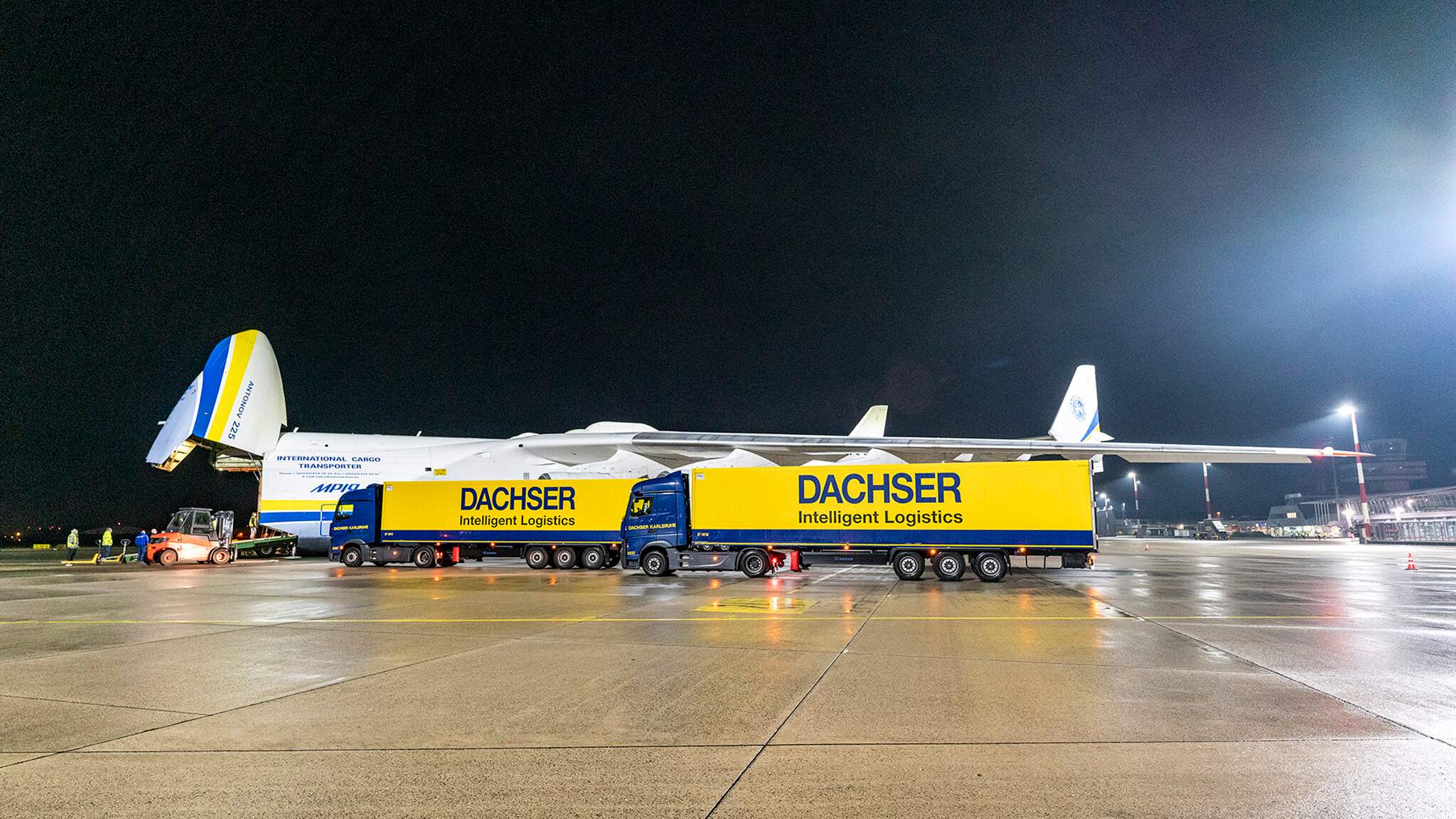
DACHSER Air & Sea Logistics' international teams have chartered the world's largest cargo aircrafts, the Antonovs AN-124 and AN-225. The aircrafts transport medical goods from China to Austria on multiple occasions for a customer, after which DACHSER redistributed the goods through its overland network.
DACHSER Air & Sea Logistics' international teams have chartered the world's largest cargo aircrafts, the Antonovs AN-124 and AN-225.
On December 7, the Antonov An-225 landed late in the evening at Linz Airport in Hörsching, Austria. The freighter had departed two days earlier from Tianjin Airport in China. Taking into account the current Corona measures, the entire cargo was reloaded immediately after landing onto around 20 trucks from DACHSER European Logistics for further distribution.
This was just the start. Another seven flights with medical supplies are still expected in Linz from Tianjin and Chengdu. Their cargo will also be delivered to the customers again by DACHSER European Logistics after landing.
Teamwork and close cooperation make it possible
DACHSER benefits from its integrated network capabilities and can thus offer a complete solution from a single source. Major projects on this scale can only be implemented through coordinated, international cooperation between the air freight organizations and the involvement of DACHSER European Logistics.
The DACHSER Air network has become an elementary component in recent years and plays a central role in strategic air freight development. Even in times of crisis, DACHSER offers its customers a stable air freight network and creative, intelligent solutions.
DACHSER South Africa expands coastal cross-docking facilities
Cross-docking, where inbound cargo is unloaded from an incoming container, sorted and then loaded directly to outbound carriers, is an important logistics strategy that keeps supply chains moving in a productive, effective manner. Logistics leader, DACHSER South Africa, has recently expanded its Durban operations to a new 3600sqm warehouse in Pinetown, Durban.
“The new off-loading and loading bays have increased our capacity to handle a number of containers at a time, enabling us to offer excellent turn-around times,” says Detlev Duve, DACHSER South Africa, Managing Director, “The facility provides a dedicated central site for products to be sorted for delivery to multiple destinations in the most productive way, saving costs. Ultimately, our customers benefit from a more efficient supply chain.”
Deidre Smith, DACHSER Sea Freight Imports Manager, says, “We’re able to consolidate shipments, or even break down larger shipments into smaller loads, for easier delivery. Storage and handling costs can be reduced as products spend less time in the warehouse. Cargo also typically reaches its final destination faster, giving our customers a competitive edge.”
Further to a spacious, well-equipped warehouse, Smith says that experienced staff and effective planning are the foundations of a successful operation. “Skilled staff are vital to the operation and management of the warehouse. From expert inventory control using Warehouse Management Systems, through to our material handling equipment operators and cargo handling teams, we ensure that all our staff are well-trained and clear on the different goods and requirements of our customers.”
Smith explains that the goods that are most conducive to cross-docking are those that are in steady demand, usually higher volume, fast-moving products scheduled in regular dispatches to pre-planned destinations. DACHSER also has the experience to handle large or complex items. “Of course, the preferred cargo to handle is stackable, palletised cargo that fits neatly into racks can be easily transported, but we’ve become experts in handling the odd and awkward cargo too. Taking care of customers cargo and avoiding damages is our top priority, and our Durban handling team has the experience to load the trucks safely and correctly. We also ensure that the appropriate handling equipment is available when off-loading a container and manoeuvring the cargo around the warehouse.”
The DACHSER team handles both Pre-Distribution, where goods are unloaded and despatched according to set distribution instructions, and Post-Distribution processes, usually for retailers, which entails flexible picking and packing according to demand, based on in-store inventory, sales forecasts and trends. Duve says it is also essential to partner with reputable transporters that offer a regular and reliable service to move the goods from warehouse to customer door.
“With all the right foundations in place, cross-docking has become part of the seamless supply chain solution DACHSER South Africa offers to our customers, which further includes contract logistics, value-added warehousing, customs clearance and customs warehousing services,” says Duve.
About DACHSER:
A family-owned company headquartered in Kempten, Germany, DACHSER is a leading supplier of logistics services worldwide.
DACHSER offers comprehensive transport logistics, warehousing, and customer-specific services in two business fields: DACHSER Air & Sea Logistics and DACHSER Road Logistics. The latter consists of two business lines: DACHSER European Logistics and DACHSER Food Logistics. Comprehensive contract-logistics services and industry-specific solutions round out the company’s offerings. A seamless shipping network—both in Europe and overseas—and fully integrated IT systems ensure intelligent logistics solutions worldwide.
Thanks to some 30,995 employees at 393 locations all over the globe, DACHSER generated revenue of 5.66 billion euros in 2019. That same year, the logistics provider handled a total of 80.6 million shipments weighing 41. million metric tons. Country organizations represent DACHSER in 44 countries.
Step by step toward the goal — Sea freight groupage containers facilitate the continuous flow of goods
In turbulent economic times, sea freight groupage containers are becoming increasingly popular. Production bottlenecks, fragile global supply chains, and a container shortage have further increased the demand for small and predictable shipment sizes in sea freight. Michael Kriegel, Department Head DACHSER Chem Logistics, explains the service that enables a reliable flow of goods in sea freight. He also talks about why a good network connection is crucial, especially for goods with high security requirements.
Sea freight groupage containers facilitate the continuous flow of goods
Companies are already analyzing their global supply chains and increasingly shifting their shipments to sea freight groupage (called “less than container load,” or LCL for short). The big advantage of groupage for customers is that they can ship smaller loads without having to pay for a full container. As a result, they can maintain a continuous flow of goods, even in the event of production bottlenecks, and also respond more flexibly to seasonal fluctuations. LCL containers are often prioritized over full containers in the loading process, which provides an additional time advantage and allows for better planning of transportation times. DACHSER markets what it calls “consolidation boxes” - customers pay only for the space they actually occupy in the containers. In addition, the company plans departures weeks in advance rather than only once production volumes are known. This means that containers, which are still in short supply, can be pre-booked in good time and customers retain flexibility when booking.
Many companies, especially in the automotive, life science, and healthcare industries, have been using groupage shipments by sea for years. But this service is also suitable for the chemical industry, which places particularly high demands on safety and transparency during transport - and thus needs a logistics provider with the appropriate experience. DACHSER is one such provider. It set up a purchasing partnership with the German Chemical Industry Association (Verband der Chemischen Industrie e.V., or VCI) in 2009. This successful alliance for European groupage shipments from Germany was then expanded in 2015 to include air and sea freight. Member companies of the association now benefit from globally standardized core services in the groupage network - transport, warehousing, and IT solutions. All this specialist industry experience has been pooled in the DACHSER Chem Logistics team.
“In shipments from customers in the chemical industry, which sometimes contain dangerous goods, the decisive factor is always safety. We have to protect life, limb, and the environment,” says Claus Freydag, Managing Director DACHSER Air & Sea Logistics Germany. “DACHSER also boasts global dangerous goods expertise in the groupage container segment and covers all LCL-compatible IMO classes in its own network and in its partner network,” he adds. The company’s central dangerous goods management system and its more than 250 regional safety advisors monitor compliance with special regulations governing the transport of dangerous goods. In addition, many DACHSER employees are trained annually in the particular requirements of chemical logistics.
For sea freight groupage, the sea freight team consolidates various LCLs and loads them into a full container. This optimizes utilization of container capacity, which in turn provides the basis for economical transport costs. Maximum utilization also improves transport sustainability while reducing the risk for individual companies at a time when supply chains are fragile. “Ports around the world have been clogged for months, causing significant delays - and making it rare, if not impossible, for shipping companies to stay on schedule. Instead of sending a full container on its way, which can get held up if loading windows are missed, more and more customers are opting for sea freight groupage containers. This reduces their risk by spreading it over several departures and ships and ensures a more timely transport,” Freydag explains.
Intelligent logistics solutions and a strong network are crucial
Demand for LCL services will continue to grow, even apart from the impact of the pandemic. That’s why DACHSER, as a market leader in the German and European groupage market, has also expanded its maritime LCL network to include 70 weekly direct services to and from Germany. “With a focus on the main global routes, we are systematically expanding our dangerous goods capacity as well. This of course means serving the major markets in both the eastern and western hemispheres, such as China, India, and the US,” Freydag says. In 2021, DACHSER shipped around 19,700 cbm of dangerous goods as LCL with customers in the chemical industry. Dangerous goods thus already represent 15 percent of DACHSER ASL Germany’s LCL business. In addition to the usual port-to-port services, DACHSER also operates various direct import services to the hinterland or other European cities. For example, once a week LCL groupage containers travel directly from port locations such as Hong Kong, Shanghai, and Ningbo to ports such as Hamburg and Bremen - but also with direct loading to Frankfurt, Kaufbeuren, Cologne, Munich, Nuremberg, Stuttgart as well as Copenhagen and Gothenburg. Direct loading minimizes the risk of cargo damage and provides additional safety by eliminating deconsolidation at the transit terminal.
Furthermore, this increases profitability and achieves additional lead time advantages by rectifying bottlenecks in the port. “DACHSER’s global network connects all groupage transports on land and water. We link our own sea freight groupage container services to and from Germany to the comprehensive range of services offered by DACHSER European Logistics, thus enabling end-to-end service throughout Europe,” Freydag says. For storage and unloading, DACHSER is increasingly using its own branch infrastructure in addition to the standard container freight stations (CFS) at the ports. When port capacity is limited, companies thus benefit from additional dispatch quality and shorter transit times.
This concept, in keeping with the idea of “everything from a single source” links the European overland transport network with the global sea freight network - a feature that not every company can offer. “Thanks to the end-to-end solution of our LCL product, which goes beyond just sea transport, we can maintain high quality across the aforementioned carriers and offer transparent traceability of the goods,” Freydag adds.
The past two years have seen risk minimization in the global movement of goods become a crucial factor for success. To take full advantage of LCL shipping, it is crucial that pick-up and onward carriage are also handled in an integrated manner, thus ensuring expertise in the safe transport of dangerous goods along the entire transport route.
Customer confidence strengthened: Dachser is satisfied with the year´s results
Virtually no dip in company revenue in 2020, the year blighted by Covid-19, with the strong second half offsetting the impact of the European lockdowns in April and May. Investments of EUR 190 million earmarked for logistics capacity, technical equipment, and digital systems.
Kempten, April 13, 2021 - Dachser can look back on a successful 2020, which was characterized by the loyalty and climate of mutual trust between the logistics provider, its customers, and its transport partners. Dachser’s consolidated net revenue totaled EUR 5.61 billion, a slight decrease of 0.9 percent compared to the previous year.
Women leading in logistics - Fearless female: Sera Fineberg
While the logistics field still tends to dominated by men, times are changing and the fairer sex is increasingly building successful careers in logistics. DACHSER South Africa is working hard to redress the gender inequalities in the industry. We’re chatting to fearless women who are playing vital roles in the DACHSER South Africa offices.
Sera Fineberg is the Johannesburg Branch Manager of Air and Sea Logistics at DACHSER South Africa and she has been with the company for 28 years. She believes that women should play a big role in the logistics industry.