
DACHSER wins the 2019 IMD Global Family Business Award
IMD recognized DACHSER for robust corporate and family governance structures combined with operational excellence and a focus on quality. IMD Business School, a top-ranked global business school headquartered in Lausanne, Switzerland, awarded DACHSER with the renowned IMD Global Family Business Award. On behalf of the company and the founding family, Bernhard Simon, CEO of DACHSER, and Birgit Kastner-Simon, Corporate Director Corporate Marketing, accepted the award at the 30th Summit of the Family Business Network International (FBN-I) in Udaipur, India.
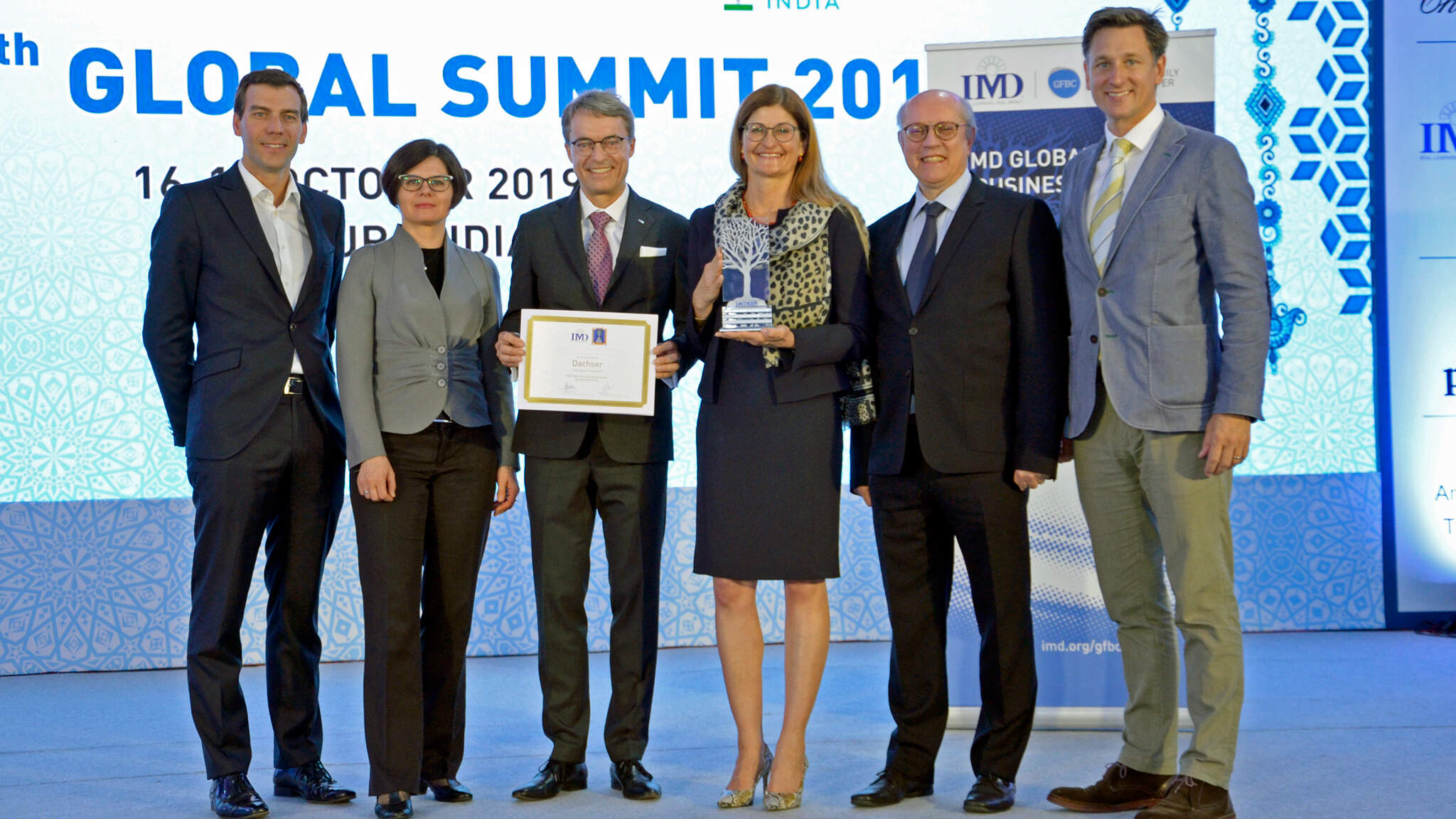
Prof. Peter Vogel, Director of IMD Global Family Business Center; Marta Widz, IMD Research Fellow; Bernhard Simon, CEO DACHSER SE; Birgit Kastner-Simon, Corporate Director Corporate Marketing, DACHSER SE; Prof. Benoit Leleux, IMD Global Family Business Award Director; Matthew Crudgington, Associate Director, IMD Global Family Business Center
Awarded since 1996, the prize recognizes large, global, and multigenerational family businesses that are exemplary in uniting family and business interests, combining tradition and innovation with clear corporate social responsibility imperatives. A panel of independent experts finally selects the award winner. “DACHSER is an outstanding family enterprise that has successfully adopted a comprehensive governance system balancing the influences of the family and the company,” commented IMD president Jean-François Manzoni. “DACHSER’s success is a testament to three generations of family owners who have built up one of the most sustainable family businesses anywhere in the world.”

“Quality is always delivered by people. That’s why we constantly strive to maintain a harmonious balance between global growth on the one hand and, on the other, the value system and the human dimension of being a family-owned company.”
Bernhard Simon, CEO DACHSER
IMD recognized DACHSER for its robust corporate and family governance structures combined with operational excellence and a focus on quality. DACHSER has stayed true to its core business and continues to stand out through strong values, sustained growth, and a truly global reach. It has also placed significant importance on innovation and sustainability in the area of economics, ecology, and society.
Quality is always delivered by people
“The IMD Global Family Business Award is a sign that we’re on the right track. DACHSER’s success is founded on a clearly defined mission and strong values that we live by every day. This ensures that everyone worldwide is able to understand our long-term strategy, and it puts the company on a secure footing for future generations. Yet another reason this award is very meaningful for me.” explains Bernhard Simon, CEO DACHSER SE.
DACHSER Air & Sea Logistics is extending its charter program on the route between Shanghai and Frankfurt to cover the period from May 2022 to April 2024. This enables the logistics provider to continue to offer its customers reliable transport capacity. DACHSER flies a widebody aircraft between Asia and Europe two days a week, transporting 33 metric tons at a time.
DACHSER’s charter program offers the company’s air freight customers additional capacity they can rely on in their planning—especially now that the trade lanes between Asia and Europe have been hit hard by the lockdown in Shanghai as well as the war in Ukraine and the accompanying sanctions. “Our customers’ demand for charter capacity remains as high as ever,” says Timo Stroh, Head of Global Air Freight at DACHSER. “That’s why we’ve created our own transport network with regular connections between Asia, Europe, and North America: to be able to offer flexible solutions here.”
An option in challenging times
Air freight is also feeling the effects that the current situation is having on the world markets. While capacity was already in short supply before the pandemic, the situation has deteriorated significantly in recent months. The closure of airspace due to the war in Ukraine makes flights about two and a half hours longer. This means they need to carry more fuel, the cost of which has gone up and the weight of which reduces the possible cargo load.
“Operating our own charter connections opens up options for capacity and gives us a degree of independence in terms of handling,” Stroh says. DACHSER’s air freight network is also closely linked to its European overland transport network, so customers benefit from end-to-end transportation of their air freight shipments between Europe and Asia. “Even in these turbulent economic times, we stand by our own charters, ensuring predictable transport capacity for our customers.”
Logistics - that also means accepting and mastering challenges again and again. Especially when things get difficult. That is why we at DACHSER are approaching 2024 with great confidence and drive, even though we are still confronted with weak, volatile markets and rising costs. Thoughts by CEO Burkhard Eling.
Step by step toward the goal — Sea freight groupage containers facilitate the continuous flow of goods
In turbulent economic times, sea freight groupage containers are becoming increasingly popular. Production bottlenecks, fragile global supply chains, and a container shortage have further increased the demand for small and predictable shipment sizes in sea freight. Michael Kriegel, Department Head DACHSER Chem Logistics, explains the service that enables a reliable flow of goods in sea freight. He also talks about why a good network connection is crucial, especially for goods with high security requirements.
Sea freight groupage containers facilitate the continuous flow of goods
Companies are already analyzing their global supply chains and increasingly shifting their shipments to sea freight groupage (called “less than container load,” or LCL for short). The big advantage of groupage for customers is that they can ship smaller loads without having to pay for a full container. As a result, they can maintain a continuous flow of goods, even in the event of production bottlenecks, and also respond more flexibly to seasonal fluctuations. LCL containers are often prioritized over full containers in the loading process, which provides an additional time advantage and allows for better planning of transportation times. DACHSER markets what it calls “consolidation boxes” - customers pay only for the space they actually occupy in the containers. In addition, the company plans departures weeks in advance rather than only once production volumes are known. This means that containers, which are still in short supply, can be pre-booked in good time and customers retain flexibility when booking.
Many companies, especially in the automotive, life science, and healthcare industries, have been using groupage shipments by sea for years. But this service is also suitable for the chemical industry, which places particularly high demands on safety and transparency during transport - and thus needs a logistics provider with the appropriate experience. DACHSER is one such provider. It set up a purchasing partnership with the German Chemical Industry Association (Verband der Chemischen Industrie e.V., or VCI) in 2009. This successful alliance for European groupage shipments from Germany was then expanded in 2015 to include air and sea freight. Member companies of the association now benefit from globally standardized core services in the groupage network - transport, warehousing, and IT solutions. All this specialist industry experience has been pooled in the DACHSER Chem Logistics team.
“In shipments from customers in the chemical industry, which sometimes contain dangerous goods, the decisive factor is always safety. We have to protect life, limb, and the environment,” says Claus Freydag, Managing Director DACHSER Air & Sea Logistics Germany. “DACHSER also boasts global dangerous goods expertise in the groupage container segment and covers all LCL-compatible IMO classes in its own network and in its partner network,” he adds. The company’s central dangerous goods management system and its more than 250 regional safety advisors monitor compliance with special regulations governing the transport of dangerous goods. In addition, many DACHSER employees are trained annually in the particular requirements of chemical logistics.
For sea freight groupage, the sea freight team consolidates various LCLs and loads them into a full container. This optimizes utilization of container capacity, which in turn provides the basis for economical transport costs. Maximum utilization also improves transport sustainability while reducing the risk for individual companies at a time when supply chains are fragile. “Ports around the world have been clogged for months, causing significant delays - and making it rare, if not impossible, for shipping companies to stay on schedule. Instead of sending a full container on its way, which can get held up if loading windows are missed, more and more customers are opting for sea freight groupage containers. This reduces their risk by spreading it over several departures and ships and ensures a more timely transport,” Freydag explains.
Intelligent logistics solutions and a strong network are crucial
Demand for LCL services will continue to grow, even apart from the impact of the pandemic. That’s why DACHSER, as a market leader in the German and European groupage market, has also expanded its maritime LCL network to include 70 weekly direct services to and from Germany. “With a focus on the main global routes, we are systematically expanding our dangerous goods capacity as well. This of course means serving the major markets in both the eastern and western hemispheres, such as China, India, and the US,” Freydag says. In 2021, DACHSER shipped around 19,700 cbm of dangerous goods as LCL with customers in the chemical industry. Dangerous goods thus already represent 15 percent of DACHSER ASL Germany’s LCL business. In addition to the usual port-to-port services, DACHSER also operates various direct import services to the hinterland or other European cities. For example, once a week LCL groupage containers travel directly from port locations such as Hong Kong, Shanghai, and Ningbo to ports such as Hamburg and Bremen - but also with direct loading to Frankfurt, Kaufbeuren, Cologne, Munich, Nuremberg, Stuttgart as well as Copenhagen and Gothenburg. Direct loading minimizes the risk of cargo damage and provides additional safety by eliminating deconsolidation at the transit terminal.
Furthermore, this increases profitability and achieves additional lead time advantages by rectifying bottlenecks in the port. “DACHSER’s global network connects all groupage transports on land and water. We link our own sea freight groupage container services to and from Germany to the comprehensive range of services offered by DACHSER European Logistics, thus enabling end-to-end service throughout Europe,” Freydag says. For storage and unloading, DACHSER is increasingly using its own branch infrastructure in addition to the standard container freight stations (CFS) at the ports. When port capacity is limited, companies thus benefit from additional dispatch quality and shorter transit times.
This concept, in keeping with the idea of “everything from a single source” links the European overland transport network with the global sea freight network - a feature that not every company can offer. “Thanks to the end-to-end solution of our LCL product, which goes beyond just sea transport, we can maintain high quality across the aforementioned carriers and offer transparent traceability of the goods,” Freydag adds.
The past two years have seen risk minimization in the global movement of goods become a crucial factor for success. To take full advantage of LCL shipping, it is crucial that pick-up and onward carriage are also handled in an integrated manner, thus ensuring expertise in the safe transport of dangerous goods along the entire transport route.
To mark the occasion: update of our Brexit checklist
The EU withdrawal of the United Kingdom was completed on 31.01.2020. Currently we are in a transition phase which ends on 31.12.2020. A further extension of this transitional phase should have been agreed until 01.07.2020 and is therefore no longer possible. Thus, the United Kingdom will no longer be part of the internal market and the customs union as of 01.01.2021. If no agreement is reached between the UK and the EU in the remaining time of the transition phase, trade would in future fall under the rules of the World Trade Organization.
We at DACHSER cannot influence the political situation in the UK, but we can prepare you in the best possible way for regulated customs procedures. We have therefore adapted and updated our Brexit checklist to the current circumstances. You can download it here free of charge.
If you have any questions, please get in touch with your responsible contact person at the respective DACHSER branch