
In a world where job-hopping has become the norm and people even have several different careers in a lifetime, global logistics company DACHSER has an unusually large number of staff who have built long term logistics careers within the company. Kurt Aufschneider has now been working in Air & Sea Logistics for over 46 years, having joined DACHSER at 17. This makes him one of the longest-serving employees in the family company which has offices in 44 countries, including South Africa. He recalls company founder Thomas Dachser giving him some unforgettable advice: “Good prep work means less re-work.” It is a motto he has lived by ever since.
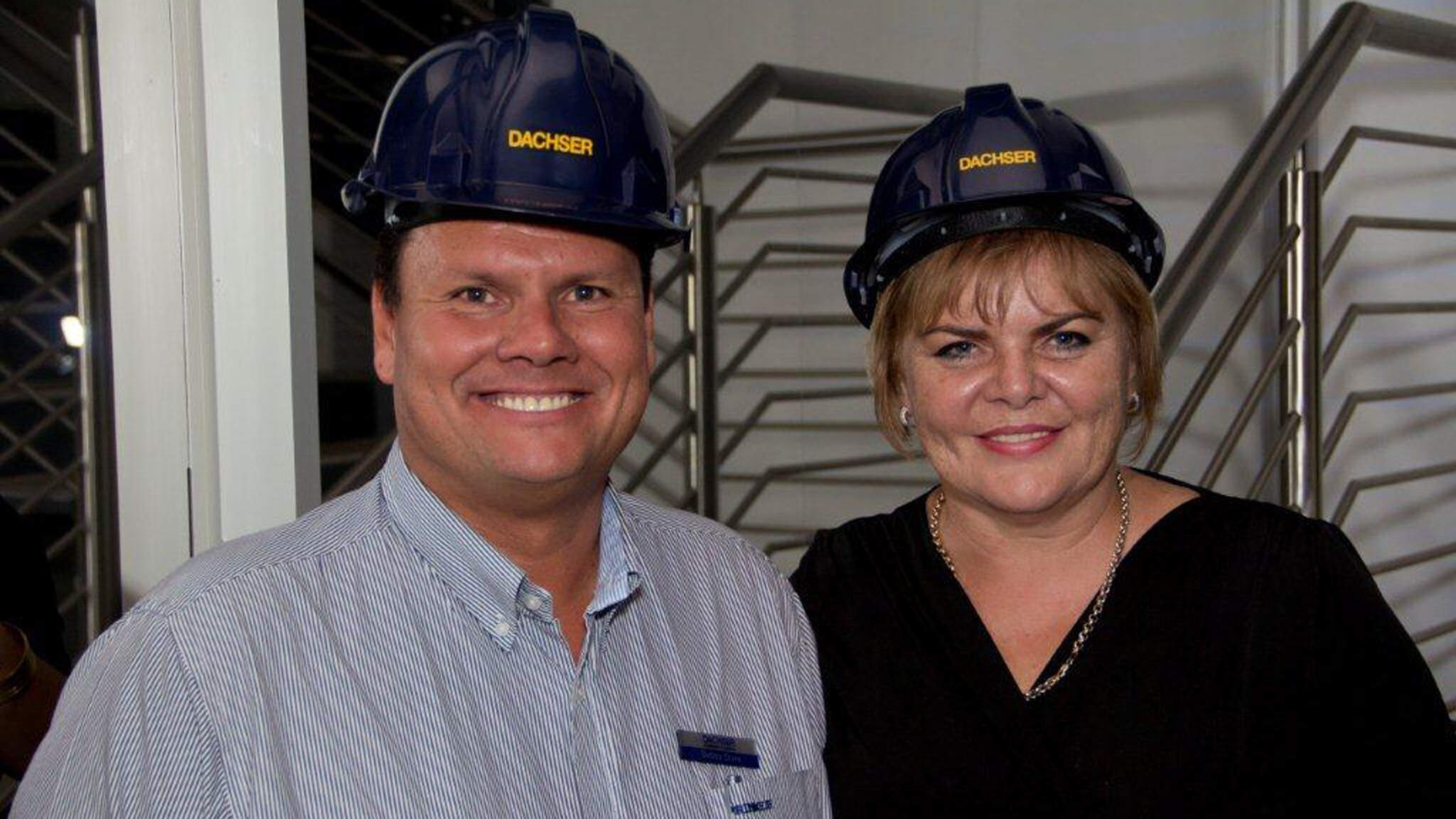
From left: Detlev Duve, Managing Director DACHSER South Africa, and Sera Fineberg, Branch Manager Air and Sea Logistics DACHSER South Africa
In Germany, where Aufschneider is based, over 10 percent of the 16 300 employees have been at the company for more than 20 years. At DACHSER South Africa, founded as family business Jonen Freight by Hartmut Duve before being acquired by DACHSER in 2011, over 15 percent of the employees have been with the company for more than 15 years, most of them more than 20. DACHSER SA celebrates 40 years of being in business this November.
We value the loyalty our staff have shown through the years, and we focus on giving everyone opportunities to gain skills and grow. The experience and in-depth knowledge of logistics in Africa, our new systems and our clients’ needs is essential to the business. They create and sustain the family business culture we’re proud of at DACHSER, and the long-term personal relationships we have with our clients.
Detlev Duve, Managing Director DACHSER South Africa
Sera Fineberg, the Branch Manager Air and Sea logistics at DACHSER in Johannesburg has been with the company since 1991 and is one of South Africa’s longest serving employees. She advanced from a sales role where she was tasked with expanding the logistics network of the then Jonen Freight beyond German route. Sera recalls that Hartmut Duve was always extremely positive and prepared to listen to ideas and support them. “He didn’t take nonsense – but inspired people and gave them opportunities. It was great to see the changes as our network grew and we signed on major accounts with clients who still trust as with their business. The hard work has been worth every minute for the recognition and the growth I’ve received.”
High standards and strong business ethics
Like many who pursue a career in logistics, Sera Fineberg describes herself as an adrenalin junkie and she loves the constant activity. She has stayed with DACHSER as she believes it is a great company to work for, and intends to remain until retirement. “DACHSER has high standards, strong business ethics and watertight compliance. I’m proud to have been a part of building the brand in South Africa in an industry that challenges you every day. It’s a real achievement to have built the reputation and the skilled staff that DACHSER has in South Africa. Corporate clients now come to us knowing the brand and stay with us for our exceptional service.”
On-site partnerships ensure DACHSER serves medical logistics needs
From specialised Stiegelmeyer hospital beds, to Dr. Reddy’s pharmaceuticals to carefully calibrated medical equipment for Welch Allyn, DACHSER South Africa is delivering essential medical supplies throughout South Africa for a number of medical clients – ensuring that medical providers have the equipment they need in this challenging time.
“The Dachser team has considerable experience in medical and pharmaceutical delivery, which has stringent health and safety compliance requirements,” says DACHSER SA managing director Detlev Duve. “We must also be able to support our clients in responding rapidly and effectively to growing needs during COVID-19. DACHSER has continued to operate effectively during lockdown with a dedicated team of home-based office staff and skeleton staff at all of our depots and local delivery centres. The entire supply chain is fully operational and on track for essential items.”
Duve says on-site partnerships and effective communications have been a key element of success in the specialist field of medical logistics. DACHSER is able to offer clients specialised warehousing and office space at the company’s Pomona head-office and five clients currently benefit from on-site offices.
When specialised hospital bed supplier Stiegelmeyer contracted with Dachser four years ago, the German manufacturer was importing beds to South Africa. They soon moved from their original Centurion premises and to the DACHSER premises in Kempton Park, facilitating a strong partnership and seamless logistics that has grown with the business as they expanded to exporting into Africa. Besides a full range of hospital beds supplied to largely private sector hospitals in South Africa, Stiegelmeyer has been exporting refugee beds across borders. With the COVID-19 pandemic taking hold, the need for these beds may increase locally as well, and the DACHSER team is ready to handle increased volumes.
Theuns Burger of Stiegelmeyer says, “Interventions in response to the Coronavirus are currently impacting life at all levels. As a supplier to the medical field, we’re committed to doing whatever necessary to remain true to our healthcare mandate and to be able to react to special demands for supplies and services, even at very short notice. We have implemented extensive measures in our production and supply chain and DACHSER is an critical partner in ensuring that we are able to deliver across Southern Africa.”
Burger says the company chose DACHSER as the team was able to offer a well-priced, full solution for importing, exporting, warehousing and distribution. “With an office on site, we have full access to our stock at all times. Working on-site has resulted in considerable efficiencies and cost-savings for our business. The Dachser team has a strong understanding of our business and we have been very happy with their service levels as a longterm supply chain fulfilment partner.”
Stiegelmeyer has a dedicated pick and pack area and space for display models, with beds built to client specifications at the DACHSER warehouse.DACHSER move up to 40 beds at time, many of which are high value items. The service includes unpacking and installing the beds in hospitals, and at times removing the older beds that the new stock will replace. This process requires health and safety preparation work and liason with the hospitals. Dachser co-ordinate with the Stiegelmeyer team to ensure that their sales executives are always there to sign off once beds have been installed.
Welch Allyn, a supplier of medical equipment, requires rigorous logistics management to ensure that their products reach medical rooms, hospitals and clinics in the perfect condition, and at the right time, in both urban centres and rural areas. Their range includes products from basic syringes to specialist cardiopulmonary equipment and patient monitoring systems.
Welch Allyn staff are also located at the DACHSER warehouse, working closely with logistics teams to take care of medical product calibration and other specialist requirements while these products are in storage and transit. When products include high-cost, sophisticated technological equipment, error-free picking and packing is critical. In the company’s decade-long relationship with the client, stock has never once had to be written off, which is a massive achievement given that Dachser has moved millions of units of stock for the business over the years.
Duve says DACHSER's picking and packing service forms part of a continuous process that only concludes once products reaches its final destination. “Medical products are picked and packed to particular specifications that include temperature control and movement reduction. We make sure this remains consistent in transit, until the product has been handed over at the final point. Our picking and packing is further supported by a sophisticated IT system which enables the transparent coordination of complex activities and real-time information for clients on their stock.”
Duve concludes, “Clients entrust us with an important part of their business at critical times, and our service levels must remain consistent whatever the challenges may be. As a logistics company, our business is to understand this trust and to grow it into a successful logistics partnership.”
Current situation in India and the impact on DACHSER’s operations
Regarding the current situation in India, we would like to give an update about DACHSER’s operations in India. The situation as of today, April 28, 2021, is as follows:
DACHSER branches in India:
Most branch offices across India are being kept closed as a precautionary measure due to the sudden rise of COVID cases. Our teams are working from home, with only skeletal staff at the offices and hence there are likely to be delays in responses due to the ongoing crisis.
As a consequence of the lockdown, there are some operational impacts for air, sea, customs clearance and domestic trucking.
Air Freight:
Most countries have barred passenger traffic from India leading to no passenger carrying flights operating on International routes from/to India.
This has created some additional constraint on already stressed space availability situation.
Rates are bound to inch upwards for all sectors.
Transit times too have increased as a consequence of capacity crunch.
Sea Freight:
Sea freight was already facing the challenges due to the Suez Canal blockage end of March. Ports and terminals are functioning normally, but vessel schedules are impacted by the Suez Canal blockage as well as the sudden rise of COVID cases in India.
Therefore delays are expected. Customers are advised to factor in delays of 1-2 weeks while planning their inventories.
Expect more delays in communication or operations due to increasing COVID infections among staff at ports, customs, CFS and shipping lines.
Customs:
We do not have any unexpected disruptions in cargo movement in India, nor is any work stoppage expected at present.
Customs clearance activities are functional at the movement.
Customs is working with less manpower, no Customs Brokers is allowed to meet the customs officials, all processes is done faceless and things are moving in slow phase.
At DACHSER, we have undertaken significant measures to ensure our employees’ health and safety, at the same time continue to manage our day-to-day operations with minimal impact to our customers’ supply chains. Our teams are working diligently by all possible means in these testing times to assist and to overcome the challenges being faced.
Please rest assured that we will keep you updated of any changes to the current situation. In case of questions, please feel free to contact your local DACHSER representative in the region.
On January 1, Burkhard Eling became Chief Executive Officer (CEO) and Spokesperson of the Executive Board of logistics provider DACHSER. He heads the Corporate Strategy, Human Resources, Marketing executive unit, which also includes Corporate Key Account Management and the Corporate Governance & Compliance division. Eling succeeds Bernhard Simon, who will take over as Chairman of the Supervisory Board of the family-owned company in mid-2021.
Step by step toward the goal — Sea freight groupage containers facilitate the continuous flow of goods
In turbulent economic times, sea freight groupage containers are becoming increasingly popular. Production bottlenecks, fragile global supply chains, and a container shortage have further increased the demand for small and predictable shipment sizes in sea freight. Michael Kriegel, Department Head DACHSER Chem Logistics, explains the service that enables a reliable flow of goods in sea freight. He also talks about why a good network connection is crucial, especially for goods with high security requirements.
Sea freight groupage containers facilitate the continuous flow of goods
Companies are already analyzing their global supply chains and increasingly shifting their shipments to sea freight groupage (called “less than container load,” or LCL for short). The big advantage of groupage for customers is that they can ship smaller loads without having to pay for a full container. As a result, they can maintain a continuous flow of goods, even in the event of production bottlenecks, and also respond more flexibly to seasonal fluctuations. LCL containers are often prioritized over full containers in the loading process, which provides an additional time advantage and allows for better planning of transportation times. DACHSER markets what it calls “consolidation boxes” - customers pay only for the space they actually occupy in the containers. In addition, the company plans departures weeks in advance rather than only once production volumes are known. This means that containers, which are still in short supply, can be pre-booked in good time and customers retain flexibility when booking.
Many companies, especially in the automotive, life science, and healthcare industries, have been using groupage shipments by sea for years. But this service is also suitable for the chemical industry, which places particularly high demands on safety and transparency during transport - and thus needs a logistics provider with the appropriate experience. DACHSER is one such provider. It set up a purchasing partnership with the German Chemical Industry Association (Verband der Chemischen Industrie e.V., or VCI) in 2009. This successful alliance for European groupage shipments from Germany was then expanded in 2015 to include air and sea freight. Member companies of the association now benefit from globally standardized core services in the groupage network - transport, warehousing, and IT solutions. All this specialist industry experience has been pooled in the DACHSER Chem Logistics team.
“In shipments from customers in the chemical industry, which sometimes contain dangerous goods, the decisive factor is always safety. We have to protect life, limb, and the environment,” says Claus Freydag, Managing Director DACHSER Air & Sea Logistics Germany. “DACHSER also boasts global dangerous goods expertise in the groupage container segment and covers all LCL-compatible IMO classes in its own network and in its partner network,” he adds. The company’s central dangerous goods management system and its more than 250 regional safety advisors monitor compliance with special regulations governing the transport of dangerous goods. In addition, many DACHSER employees are trained annually in the particular requirements of chemical logistics.
For sea freight groupage, the sea freight team consolidates various LCLs and loads them into a full container. This optimizes utilization of container capacity, which in turn provides the basis for economical transport costs. Maximum utilization also improves transport sustainability while reducing the risk for individual companies at a time when supply chains are fragile. “Ports around the world have been clogged for months, causing significant delays - and making it rare, if not impossible, for shipping companies to stay on schedule. Instead of sending a full container on its way, which can get held up if loading windows are missed, more and more customers are opting for sea freight groupage containers. This reduces their risk by spreading it over several departures and ships and ensures a more timely transport,” Freydag explains.
Intelligent logistics solutions and a strong network are crucial
Demand for LCL services will continue to grow, even apart from the impact of the pandemic. That’s why DACHSER, as a market leader in the German and European groupage market, has also expanded its maritime LCL network to include 70 weekly direct services to and from Germany. “With a focus on the main global routes, we are systematically expanding our dangerous goods capacity as well. This of course means serving the major markets in both the eastern and western hemispheres, such as China, India, and the US,” Freydag says. In 2021, DACHSER shipped around 19,700 cbm of dangerous goods as LCL with customers in the chemical industry. Dangerous goods thus already represent 15 percent of DACHSER ASL Germany’s LCL business. In addition to the usual port-to-port services, DACHSER also operates various direct import services to the hinterland or other European cities. For example, once a week LCL groupage containers travel directly from port locations such as Hong Kong, Shanghai, and Ningbo to ports such as Hamburg and Bremen - but also with direct loading to Frankfurt, Kaufbeuren, Cologne, Munich, Nuremberg, Stuttgart as well as Copenhagen and Gothenburg. Direct loading minimizes the risk of cargo damage and provides additional safety by eliminating deconsolidation at the transit terminal.
Furthermore, this increases profitability and achieves additional lead time advantages by rectifying bottlenecks in the port. “DACHSER’s global network connects all groupage transports on land and water. We link our own sea freight groupage container services to and from Germany to the comprehensive range of services offered by DACHSER European Logistics, thus enabling end-to-end service throughout Europe,” Freydag says. For storage and unloading, DACHSER is increasingly using its own branch infrastructure in addition to the standard container freight stations (CFS) at the ports. When port capacity is limited, companies thus benefit from additional dispatch quality and shorter transit times.
This concept, in keeping with the idea of “everything from a single source” links the European overland transport network with the global sea freight network - a feature that not every company can offer. “Thanks to the end-to-end solution of our LCL product, which goes beyond just sea transport, we can maintain high quality across the aforementioned carriers and offer transparent traceability of the goods,” Freydag adds.
The past two years have seen risk minimization in the global movement of goods become a crucial factor for success. To take full advantage of LCL shipping, it is crucial that pick-up and onward carriage are also handled in an integrated manner, thus ensuring expertise in the safe transport of dangerous goods along the entire transport route.